
Cartalax: What the Research Shows and How to Verify the Peptide
Updated 18 November 2026
Cartalax is the synthetic tripeptide Ala-Glu-Asp (AED), a three-amino-acid peptide from Vladimir Khavinson’s research group in St. Petersburg. Its published record is small: PubMed links six papers to its Cartalax entry, and all six describe work in cell or tissue cultures. Renovita Research supplies Cartalax as a 20 mg lyophilized reference standard.
Below: a table of the cell studies and what each one measured, where the evidence stops, and a line-by-line read of a real Cartalax certificate of analysis. The certificate comes from the Cartalax 20mg (RESEARCH USE ONLY) page, where the full PDF is linked.
Key takeaways
- Cartalax is Ala-Glu-Asp (AED): formula C12H19N3O8, molecular weight 333.29 g/mol (PubChem CID 87815447).
- PubMed links six papers to Cartalax (searched 18 November 2026). A seventh, on cartilage cells, appeared in 2023 under the code AED.
- The papers measured proteins and gene activity in cultured cells. None measured cartilage tissue or joint function.
- In a 2011 thymus cell study, Cartalax (coded T-31) did not show the complex anti-aging effect the authors found for a different peptide.
- A Cartalax COA should confirm the 333.29 g/mol molecule by mass spectrometry, with an [M+H]+ peak near 334.
What is Cartalax?
Cartalax is the name used for alanyl-glutamyl-aspartic acid, a peptide three amino acids long. The US National Library of Medicine files it in its MeSH vocabulary under that chemical name, with “cartalax” and “T-31 peptide” listed as other names for the same compound.
- Sequence: Ala-Glu-Asp (one-letter code AED)
- Formula: C12H19N3O8
- Molecular weight: 333.29 g/mol
- Code in older papers: T-31
- PubChem record: CID 87815447
Cartalax belongs to a family of very short peptides studied at the St. Petersburg Institute of Bioregulation and Gerontology. A close relative is Epitalon, which is the same chain with one glycine added: Ala-Glu-Asp-Gly (AEDG). The two were tested side by side in the 2016 skin cell and 2019 stem cell papers below. Renovita also carries Epitalon 50mg (RESEARCH USE ONLY) for labs that study both.
The group often compares its short peptides with polypeptide complexes extracted from a single tissue. Cartalax is not one of those extracts. It is a synthetic three-amino-acid chain, and in the 2023 cartilage cell study it was measured against a cartilage polypeptide complex, a separate material.
What has Cartalax been studied for?
Cartalax has been studied in cultured cells from thymus, kidney, skin, stem cells and cartilage, and each study measured cell markers and gene activity rather than tissue repair. The table lists each paper, oldest first, with what the authors report for AED in the abstract.
| Year | Cells studied | What was measured | What the abstract reports for AED | Source |
|---|---|---|---|---|
| 2011 | Aging thymus cells in culture | Cell division, maturation, cell death | Only a different peptide, AB-9, showed a complex anti-aging (geroprotective) effect; T-31 did not | Lin’kova et al., Bull Exp Biol Med, PMID 22238759 |
| 2014 | Young and aged kidney cells | p16, p21, p53, SIRT-6; computer models of DNA binding | AED and the peptide EDL raised cell division, lowered p16, p21 and p53, and raised SIRT-6 | Khavinson et al., Adv Gerontol (Russian), PMID 25946838 |
| 2015 | Kidney tissue cultures from young and old animals | Ki-67 (cell division), p53 (cell death signal) | AED raised Ki-67 and lowered p53, but less than a calf-kidney polypeptide complex | Chalisova et al., Bull Exp Biol Med, PMID 26033601 |
| 2016 | Skin fibroblasts aging in culture | Ki-67, CD98hc, caspase-3, MMP-9 | With three other short peptides, lowered the age-related rise in MMP-9 and raised Ki-67 and CD98hc; AED was one of two that suppressed caspase-dependent cell death | Lin’kova et al., Bull Exp Biol Med, PMID 27259496 |
| 2019 | Human periodontal ligament stem cells | GAP43 and Nestin (early nerve-cell markers) | The rise was credited to a four-peptide mix and to KED alone, not to AED on its own | Caputi et al., Int J Immunopathol Pharmacol, PMID 30791821 |
| 2020 | Human fetal bone marrow stem cells, two aging models | IGF1, FOXO1, TERT, TNKS2, NFκB gene activity | AED raised NFκB gene activity in both models; IGF1 rose 3.5 to 5.6 fold with the peptides added | Ashapkin et al., Mol Biol Rep, PMID 32399807 |
| 2023 | Cartilage cells (chondrocytes) with an aging profile | p16, p21, p53, TNF-α, IL-1α, Sirt1 | AED and a cartilage polypeptide complex brought these markers back toward normal | Myakisheva et al., Adv Gerontol (Russian), PMID 37356100 |
The first six rows are the papers PubMed links to its Cartalax entry. The 2023 paper uses only the code AED and is not tagged, so a search for “cartalax” alone misses it.
Where an abstract reports an effect for AED, it is on markers of cell aging: lower p53 and p16, higher Ki-67, lower MMP-9. In two of the seven papers (2011 and 2019), the abstract credits other peptides instead of AED. The 2023 paper is the only one run on cartilage cells, and it is a five-page report in Russian.
Does the research show Cartalax rebuilds cartilage?
No. The Cartalax papers measured proteins and gene activity in cells grown in dishes, and none measured cartilage thickness, tissue repair or joint function.
What the papers measured:
- protein markers of cell aging and cell death (p16, p21, p53, caspase-3)
- markers of cell division (Ki-67)
- gene activity (IGF1, NFκB, TERT and others)
- computer models of the peptide binding DNA
What they did not measure: cartilage tissue, joints, or any clinical outcome. PubMed’s Cartalax entry holds no clinical trial. One older paper from the same group, from 2007 (PMID 18306703), tested T-31 in a rat bone-density model; it is not tagged to the Cartalax entry and sits outside the cell work covered here.
Two more facts help place the evidence. Every paper in the table lists Vladimir Khavinson, co-authors from the St. Petersburg Institute of Bioregulation and Gerontology, or both; the 2019 study was run with a stem cell lab at G. d’Annunzio University in Chieti, Italy. And a 2023 review from the same group on peptides that steer stem cells toward cartilage (Linkova et al., Int J Mol Sci, PMID 37176122) names other peptides, such as SK2.1, BMP and LPP, as the most promising. Its abstract does not single out AED.
How is Cartalax thought to act on cells?
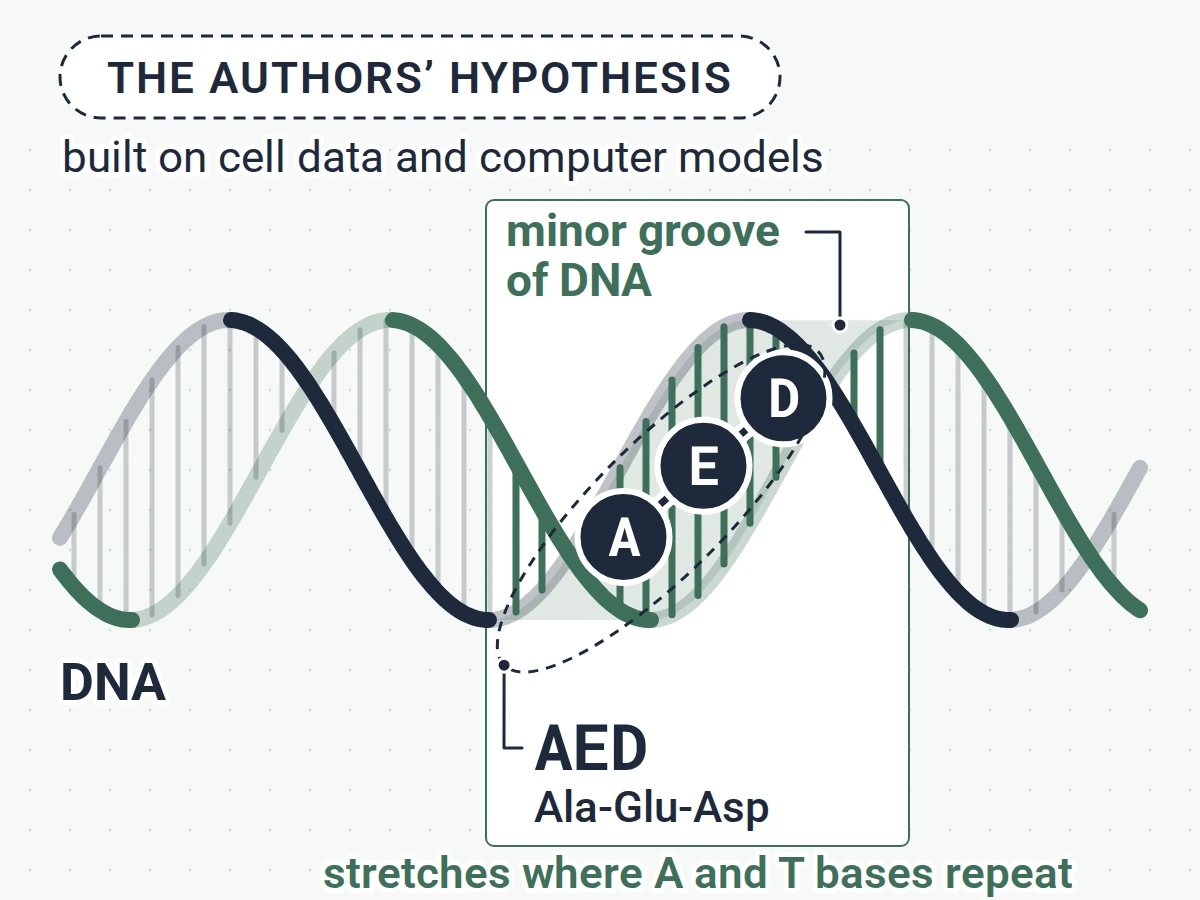
The explanation offered in these papers is that AED binds DNA directly and so changes which genes are switched on. This is the authors’ hypothesis, built on cell data and computer models.
For Cartalax, the clearest statement is in the 2014 kidney cell paper. The authors’ models had AED form its most stable complexes in the minor groove of DNA, at stretches where A and T bases repeat, and they tie that binding to the changes in aging markers they measured. None of the abstracts in the table reports a direct test of that binding inside a cell.
How to check a Cartalax vial: reading the COA
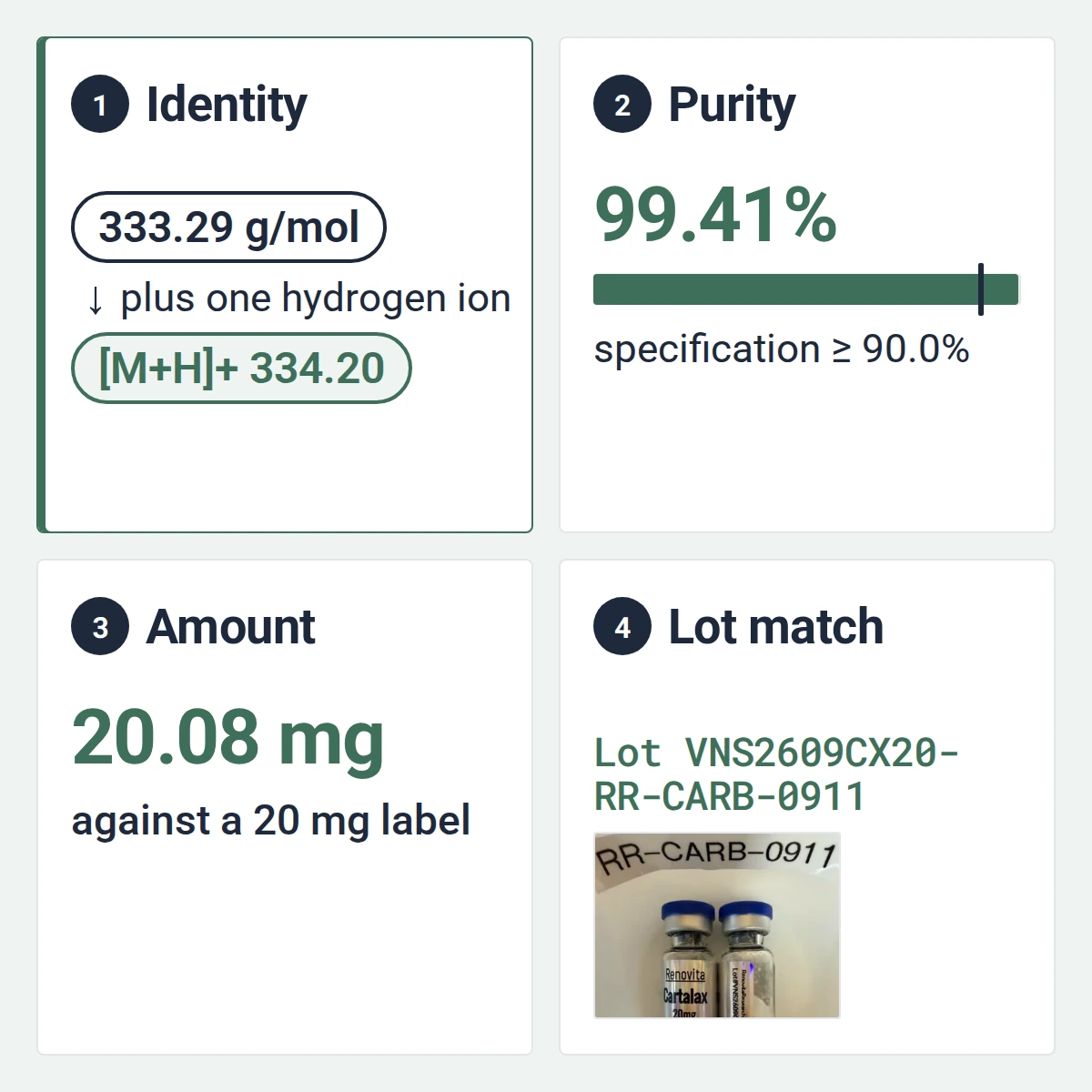
A Cartalax certificate of analysis should prove three things: the vial holds Ala-Glu-Asp, the peptide is pure, and the stated amount is there. Here is what to check, with the results on the certificate posted on Renovita’s Cartalax 20mg page (lot VNS2609CX20-RR-CARB-0911, COA number PMS-9253548213, report date 09/14/2026), issued by an independent third-party lab that tested a sample from the lot.
| Check | What to look for | Result on this certificate |
|---|---|---|
| Identity | Mass spectrometry confirms the 333.29 g/mol molecule. Its [M+H]+ peak is the molecule plus one hydrogen ion, so it sits about one unit higher, near 334 | Identity by LC-MS/MS: conforms to Cartalax. Mass spectrum labels [M+H]+ at 334.20 |
| Formula | C12H19N3O8 | C12H19N3O8, 333.29 g/mol |
| Purity | HPLC purity: the share of the main peak | 99.41% (specification ≥ 90.0%) |
| Amount | Net peptide content: the peptide’s own weight, apart from water and salt | 20.08 mg against a 20 mg label |
| Water and salt | Water by Karl Fischer, acetate by HPLC | Water 5.07%, acetate 4.00% |
| Contaminants | Heavy metals and bacterial endotoxins | Heavy metals (ICP-MS) not detected; endotoxins (LAL) not detected |
| Sterility | Whether a sterility test was run | Not tested: no sterility result for this sample |
| Lot match | The lot code on the vial label matches the certificate | Lot VNS2609CX20-RR-CARB-0911; the sample photo on the certificate shows a vial marked RR-CARB-0911 |
The identity row matters most. A purity figure only says how clean the main peak is; the mass result says what that peak is. A certificate that gives a purity percentage with no mass result, or with a mass that does not match 333.29 g/mol, does not show the vial holds Cartalax.
The full PDF, with the HPLC trace and mass spectrum, is linked on the Cartalax 20mg product page.
Buying Cartalax for laboratory research
Renovita sells Cartalax 20mg (RESEARCH USE ONLY) as one 3 ml glass vial of white lyophilized powder, stored at −20 °C or below. Like every Renovita product, it is sold strictly for laboratory and research use only, not for human or animal consumption, and ships to US addresses only.
Frequently asked questions
Is Cartalax the same as Epitalon?
No. Cartalax is Ala-Glu-Asp (AED). Epitalon is Ala-Glu-Asp-Gly (AEDG), one amino acid longer. The 2016 fibroblast and 2019 stem cell papers tested both.
What is T-31?
T-31 is the code for AED in older papers from the Khavinson group. The National Library of Medicine lists “T-31 peptide” as another name for Cartalax.
Is Cartalax made from cartilage?
No. Cartalax is a synthetic three-amino-acid peptide. The cartilage polypeptide complex it was compared with in the 2023 study is a separate tissue extract.
Is the Cartalax research in English?
Partly. The 2011, 2015, 2016, 2019 and 2020 papers are in English. The 2014 and 2023 papers are in Russian, with English abstracts on PubMed.
What should a Cartalax COA show?
A mass result that confirms the 333.29 g/mol molecule, an HPLC purity figure, the net peptide content, and a lot number that matches the vial. The certificate for the Cartalax 20mg (RESEARCH USE ONLY) vial shows all four.
