
What Is BPC-157? Sequence, Research Record and COA
BPC-157 is a synthetic peptide of 15 amino acids, sequence GEPPPGKPADDAGLV, with a molecular weight of about 1,419. Predrag Sikiric’s pharmacology group at the University of Zagreb first described it in 1993, and that group still dominates the record: on 18 November 2026, 176 of the 237 PubMed papers on BPC-157 listed Sikiric as an author.
Renovita Research supplies it as BPC-157 10mg (RESEARCH USE ONLY), a lyophilized reference standard with a lot-specific certificate of analysis. This guide covers what the molecule is, what the published work does and does not show, its regulatory status, and how to check a BPC-157 certificate against the fixed facts of the sequence.
Key Takeaways
- BPC-157 is one defined molecule: 15 residues, GEPPPGKPADDAGLV, formula C62H98N16O22, about 1,419.56 g/mol.
- About three in four PubMed records on BPC-157 (176 of 237) list Predrag Sikiric of the University of Zagreb as an author. Zero of the 237 carry PubMed’s clinical-trial publication type.
- The published work is mostly rodent and cell research. A government-funded Australian men’s health body found one human report: 16 people, no control group.
- BPC-157 is not an FDA-approved drug, and WADA bans it in sport.
- Because the sequence and mass are fixed, a vial can be checked against them on its certificate of analysis. Purity and net peptide content are two different numbers, and a good COA gives both.
What is BPC-157 made of?
BPC-157 is a pentadecapeptide, a chain of 15 amino acids, made synthetically. Sikiric and colleagues first reported it in 1993 as a fragment of a protein found in human gastric juice (Sikiric et al., Pharmaceuticals, 2025). The same group has written about its stability in gastric juice, which is unusual for a peptide (Sikiric et al., Inflammopharmacology, 2006).
Every BPC-157 vial on the market should match the same identity card:
| Property | Value |
|---|---|
| Sequence | GEPPPGKPADDAGLV (Gly-Glu-Pro-Pro-Pro-Gly-Lys-Pro-Ala-Asp-Asp-Ala-Gly-Leu-Val) |
| Length | 15 amino acids |
| Molecular formula | C62H98N16O22 |
| Molecular weight | 1,419.56 g/mol |
| CAS number | 137525-51-0 |
| Usual form | White lyophilized (freeze-dried) powder |
Source: values as printed on the certificate for Renovita’s BPC-157 10mg, lot MYA2608BP10. The sequence is the one the Zagreb group gives in its 2025 review.
Those numbers matter more than any description. A mass spectrometer either finds a molecule of about 1,419.56 or it does not, so identity is something a lab can check rather than take on trust.
On its product page, Renovita describes BPC-157 the way a reference supplier would: a peptide derived from a gastric protein sequence, characterized by stability in acidic conditions, and supplied for receptor-binding assays, peptide stability studies and structural characterization.
Who has studied BPC-157?
Most BPC-157 research comes from one group. A PubMed search for “BPC-157” returned 237 records on 18 November 2026. Adding the author Sikiric P cut that to 176 records, about 74%. The same search, run the same day, gave these counts:
- All records: 237.
- With Predrag Sikiric as an author: 176.
- Reviews: 53, of which 33 list Sikiric as an author.
- Records tagged as clinical trials: 0.
Reviews lean the same way, if a little less: 33 of the 53, about 62%, list Sikiric. The 48-page 2025 review in Pharmaceuticals lists authors from the University of Zagreb School of Medicine and the University Hospital Centre Zagreb only (Sikiric et al., 2025).
The count describes who did the work. It does not grade the work. A literature built mostly by one team leaves one open question above the rest: independent replication, meaning how many of its findings other labs have tested and confirmed. For a researcher, the original papers are the place to start.
What does the published BPC-157 research cover?
The published research on BPC-157 is almost all preclinical, meaning cell and animal work. The Zagreb group’s papers centre on rodent models of injury to the gut, tendon and muscle (Sikiric et al., 2006). Their 2025 review adds work on blood vessel formation (angiogenesis) and the nitric oxide system, plus nervous-system models in rats and mice (Sikiric et al., 2025).
Human data is thin. Healthy Male, an Australian men’s health body funded by the government, reviewed the evidence and found:
- Rodent and cell studies make up most of the literature.
- One human report, covering 16 people.
- No control group in that report.
- Authors linked to a clinic that sold the peptide.
The answer to “what does the research show” turns on which kind of research is meant: a large animal and cell literature, mostly from one group, and almost no controlled human data.
Is BPC-157 FDA approved?
No. BPC-157 is not an FDA-approved drug. Three dates set its status:
- 2023: the FDA listed it among bulk substances that may present significant safety risks in compounding.
- July 2026: an FDA advisory committee split 8 to 6, with 1 abstention, in favour of allowing it in compounding. The vote was advice, not a ruling (TIME).
- 28 October 2026: HHS said it will not take enforcement action against licensed pharmacies and physicians that compound it, as a single ingredient, on prescription (Federal Register 2026-22192).
The 2026 policy is about compounded medicines on prescription. In sport, WADA lists BPC-157 by name under S0, non-approved substances (WADA Prohibited List).
How do you read a BPC-157 certificate of analysis?
A BPC-157 certificate of analysis (COA) should prove two things: that the vial holds the right molecule, and how much of it. The certificate linked from Renovita’s BPC-157 10mg page, for lot MYA2608BP10-RR-BPCY-0819, was reported by an independent third-party lab on 20 August 2026. Renovita Research is a Missouri company, and it publishes this lot’s certificate as a PDF anyone can open before buying. Here is every line on it, and what each one tells a lab:
| Test on the COA | Specification | Result | What it tells a lab |
|---|---|---|---|
| Mass identification (LC-MS/MS) | BPC-157 confirmed | Confirmed | The molecule in the vial has the mass of BPC-157 |
| Purity (HPLC) | At least 90.0% | 99.68% | Share of the peptide signal that is BPC-157 rather than related impurities |
| Net peptide content | At least 90% of 10 mg | Pass | How much actual peptide is in the vial, against the 10 mg label |
| Water (Karl Fischer) | 10.0% or less | 4.60% | Moisture held in the freeze-dried powder |
| Acetate (HPLC) | Under 12.0% | 3.84% | Counter-ion left from synthesis and purification |
| Heavy metals (ICP-MS) | Under 10 ppm | Not detected | Metal contamination |
| Bacterial endotoxins (LAL) | Under 5 EU/mg | Not detected | Bacterial residue |
| Sterility (USP <71>) | Listed | Not tested | No sterility result on this certificate |
| Mass balance | 95.0 to 105.0% | Conforms | The parts add up to the whole |
Source: Renovita BPC-157 10mg COA, lot MYA2608BP10. The product page lists purity as at least 99% (HPLC); this lot reported 99.68%.
The analyst’s note reads: “Blended conformity on 2 vials shows on the reflected purity and net peptide content listed above.” Read plainly, those two results come from two vials rather than one. When comparing certificates, check whether each reports one vial or more than one.
Why purity and net peptide content are different numbers
Purity and net peptide content answer different questions. HPLC purity measures how much of the peptide in the sample is the right peptide. It says nothing about how much of the powder is peptide at all. A freeze-dried vial also holds water and acetate salt, so a vial can be 99% pure and still contain less peptide than its label says.
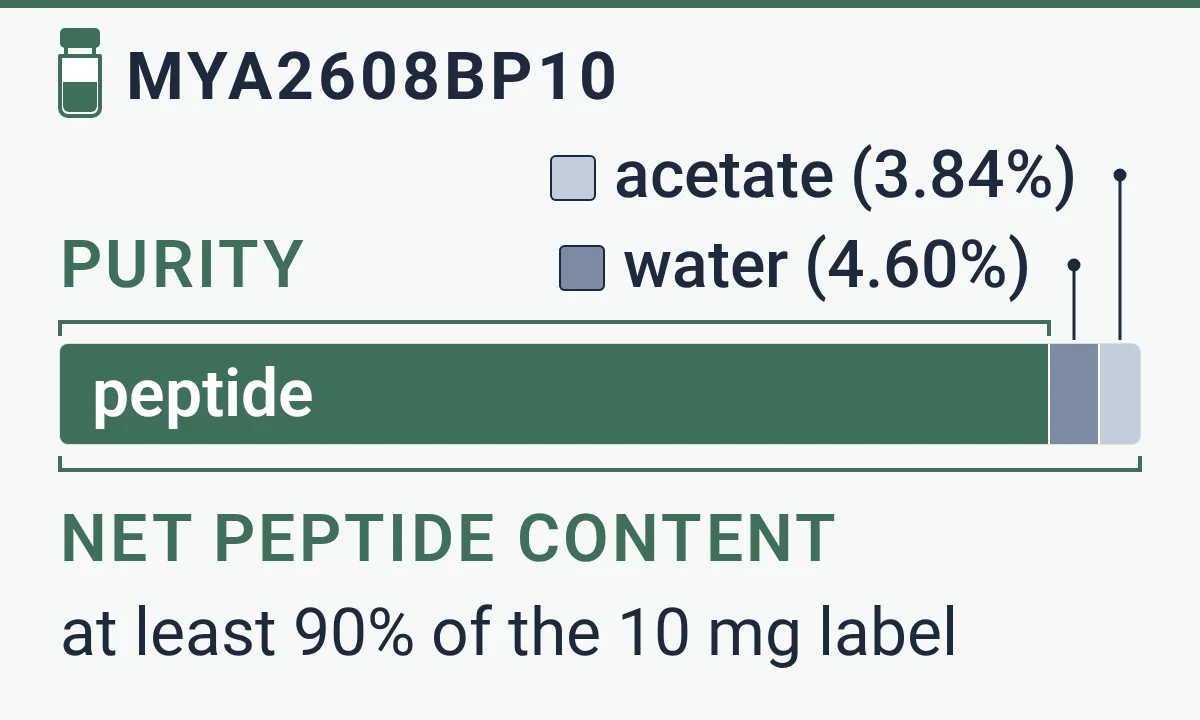
The net peptide content line closes that gap. On this lot, water (4.60%) and acetate (3.84%) are measured separately, and net peptide content passes its specification of at least 90% of the 10 mg label. A certificate that gives only a purity figure leaves the amount question open.
A five-point check for any BPC-157 COA
- Sequence: it matches GEPPPGKPADDAGLV.
- Mass: identity is confirmed by mass spectrometry, at about 1,419.56 g/mol.
- Purity: an HPLC figure, ideally with the chromatogram or the method named.
- Amount: a net peptide content figure against the label, not purity alone.
- Traceability: a lot number and test dates, which a lab can match to the vial label on arrival.
The BPC-157 10mg (RESEARCH USE ONLY) page links its certificate under the product description, so the first four points can be checked before ordering and the fifth on arrival.
Frequently Asked Questions
Is BPC-157 a peptide or a protein?
BPC-157 is a peptide. At 15 amino acids it is far too short to count as a protein, though it was first described as a fragment of a larger protein found in gastric juice.
Is BPC-157 the same as TB-500?
No. BPC-157 has 15 amino acids. TB-500 is a different peptide tied to thymosin beta-4. The two are often sold together as the “wolverine stack”, covered in our guide to the wolverine stack peptide.
What sizes does Renovita sell BPC-157 in?
Renovita sells BPC-157 in 10 mg and 20 mg vials, both as lyophilized powder.
How is lyophilized BPC-157 stored?
The product page lists storage at -20 °C or below, with reconstitution in a laboratory solvent or diluent suited to the research application.
Where to find BPC-157 10mg
Renovita sells BPC-157 as a research reference standard, strictly for laboratory and research use only and not for human or animal consumption. Renovita ships only to addresses within the United States. The full specifications and the lot certificate are on the BPC-157 10mg (RESEARCH USE ONLY) page.
