
5-Amino-1MQ: What It Is and What the Research Tested
Updated 18 November 2026
5-amino-1MQ (5-amino-1-methylquinolinium) is a small-molecule inhibitor of the enzyme nicotinamide N-methyltransferase (NNMT), not a peptide. Its published record is cell and mouse work: five PubMed abstracts reviewed here name the compound, none testing it in people, and ClinicalTrials.gov listed no registered trials for it on 18 November 2026. A vial is judged by its lot certificate.
Renovita Research, a Missouri research supply company, lists it as 5 Amino 1-MQ 50mg (RESEARCH USE ONLY), with a lot certificate of analysis on the product page. Below: a paper-by-paper table of which compound each study names and what it measured, the salt detail that changes how amounts compare, and that certificate read line by line.
Key takeaways
- 5-amino-1MQ is a quinolinium ion with no amino acids in it. Formula C10H11N2+ for the ion, C10H11IN2 for the iodide salt.
- It blocks NNMT, the enzyme that methylates nicotinamide (vitamin B3) and produces 1-methylnicotinamide (1-MNA).
- Many NNMT papers say “NNMT inhibitor” without naming the compound. Of the 15 papers below, five abstracts name 5-amino-1MQ, under four spellings and one salt name.
- One Texas group wrote most of the unnamed-inhibitor papers and two of the five that name it. Labs in China, Italy and Turkey wrote the other three.
- A vial is checked by its certificate: identity, purity, net content, water, acetate, metals, endotoxins, and what was not tested.
What is 5-amino-1MQ?
5-amino-1MQ is a methylquinolinium compound: a quinoline ring with a methyl group on the ring nitrogen and an amino group at position 5. That methylated nitrogen carries a permanent positive charge. So the molecule is an ion, and it is always made and sold with a counterion attached.
PubChem lists two forms:
| Form | PubChem CID | Formula | Molecular weight | Source |
|---|---|---|---|---|
| 5-amino-1MQ ion (1-methylquinolin-1-ium-5-amine) | 950107 | C10H11N2+ | 159.21 g/mol | PubChem 950107 |
| 5-amino-1MQ iodide (the salt) | 66522933 | C10H11IN2 | 286.11 g/mol | PubChem 66522933 |
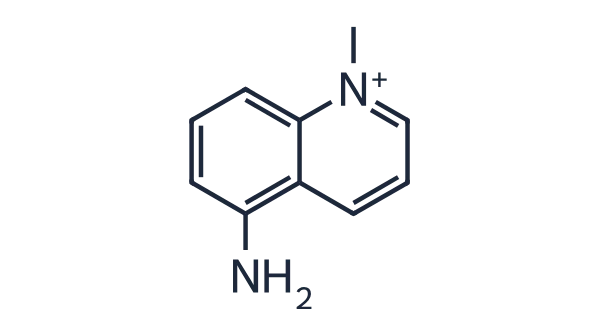
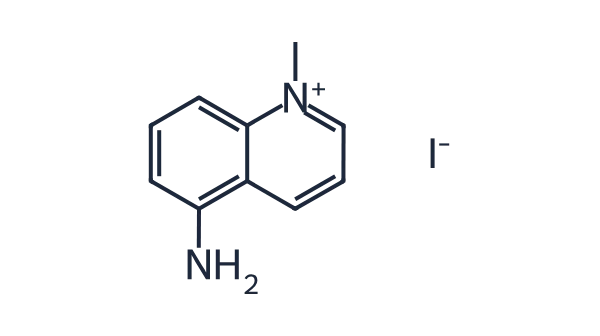
The difference matters when you compare amounts. In the iodide salt, 159.21 of every 286.11 grams is the 5-amino-1MQ ion, about 56%. So 10 mg of the iodide holds about 5.6 mg of the ion. A paper that reports milligrams of the iodide and a vial labelled in milligrams of the ion are not describing the same quantity. At least one paper names the iodide outright: the 2024 bladder cancer study used “5-Amino-1-methylquinolinium iodide” (Yang et al. 2024).
5-amino-1MQ is often sold next to research peptides and often called one. It has no peptide bonds and no amino acids: ten carbon atoms, two nitrogens, one ring system.
What does an NNMT inhibitor do?
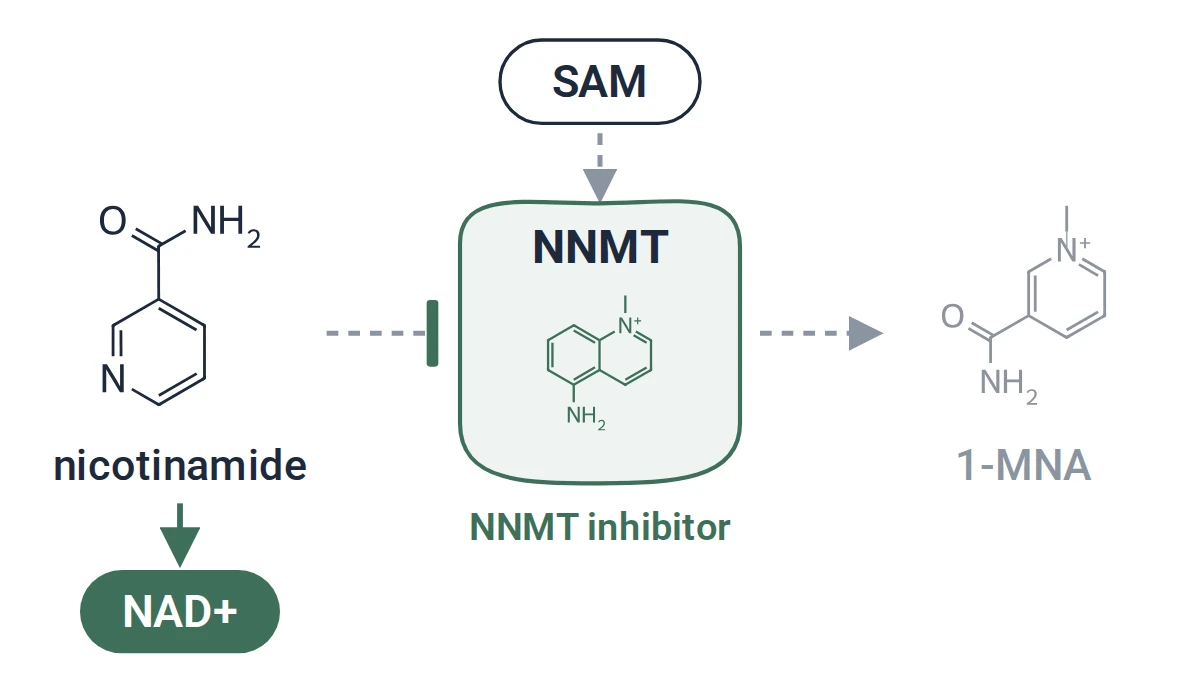
An NNMT inhibitor stops nicotinamide N-methyltransferase from adding a methyl group to nicotinamide. NNMT takes that methyl group from S-adenosylmethionine (SAM), and the product is 1-MNA. Nicotinamide is also a building block for NAD+, so blocking NNMT touches three things:
- NAD+ supply: nicotinamide that NNMT methylates is no longer available to make NAD+.
- Methyl supply: every reaction uses up one SAM, the cell’s main methyl donor.
- 1-MNA output: the methylated product, which papers measure to show NNMT activity has dropped.
The case for NNMT as a target came before any 5-amino-1MQ paper. A 2014 study in Nature knocked down NNMT in mouse fat and liver, a gene-level change rather than a compound, and reported higher SAM and NAD+ in fat tissue and higher cellular energy expenditure (Kraus et al. 2014).
The chemistry came in 2017. A University of Texas team screened N-methylated quinolinium, isoquinolinium, pyridinium, benzimidazolium and benzothiazolium compounds. The quinoliniums blocked NNMT at about 1 μM (IC50, the concentration that halves the enzyme’s activity), and docking placed them in the enzyme’s nicotinamide-binding site (Neelakantan et al. 2017). 5-amino-1MQ is an N-methylated quinolinium, the scaffold that screen picked out.
What did the 5-amino-1MQ papers actually test?
The published work around 5-amino-1MQ is enzyme assays, cell studies, mouse studies and one review, and the abstracts do not all name the compound. Read each paper by what it names. “NNMTi” in an abstract means an NNMT inhibitor; on its own it does not say which one.
| Year, journal | Compound as the abstract names it | Model | What was measured | Watowich author / Ridgeline disclosure | Link |
|---|---|---|---|---|---|
| 2014, Nature | none (knockdown of NNMT) | mice | SAM, NAD+, energy expenditure | no / no | PMID 24717514 |
| 2017, J Med Chem | quinolinium series | enzyme assays, docking | inhibition strength (IC50 about 1 μM) and binding site | yes / no | PMID 28548833 |
| 2018, Biochem Pharmacol | methylquinolinium analogues; “a potent NNMT inhibitor” in mice | membrane assays, fat cells, diet-induced obese mice | permeability, selectivity, 1-MNA, NAD+, SAM, body weight, fat mass | yes / no | PMID 29155147 |
| 2019, Biochem Pharmacol | “NNMTi” | 24-month-old mice after muscle injury; C2C12 cells | muscle stem cell activity, fiber size, peak torque | yes / no | PMID 30753815 |
| 2021, J Obstet Gynaecol | “5MQ”, defined in the abstract as 5-amino-1-methylquinolinium | HeLa cervical cancer cells | cell viability, gene and protein expression | no / no | PMID 33645410 |
| 2021, Sci Rep | “NNMTi” | diet-induced obese mice on a diet switch | body composition, liver fat, fat-tissue metabolites | yes / yes | PMID 33707534 |
| 2022, Sci Rep | 5-amino-1-methylquinolinium | diet-induced obese mice on a diet switch | gut microbiome | yes / yes | PMID 35013352 |
| 2024, Sci Rep | “NNMTi” | aged mice, with and without exercise | grip strength, running, muscle fiber size | yes / yes | PMID 38969654 |
| 2024, Diabetes Obes Metab | 5A1MQ | diet-induced obese mice, 28 days | body composition, glucose, insulin, liver histology, blood and tissue levels of the compound | yes / yes | PMID 39161060 |
| 2024, J Immunother Cancer | 5-Amino-1-methylquinolinium iodide | bladder cancer mouse models | tumor growth alongside an anti-PD-L1 antibody | no / no | PMID 39067875 |
| 2025, Biomolecules | 5-AMQ, tested with two other NNMT inhibitors | bone and skin cancer cell lines | viability, reactive oxygen species, apoptosis | no / no | PMID 41301471 |
| 2025, Physiol Rep | “NNMT inhibitor” | mice with induced limb ischemia | muscle strength, power, perfusion | no / no | PMID 41108586 |
| 2025, Pharmacol Res | AMO-NAM (a different inhibitor) | aged female mice, heart failure model | heart function, 1-MNA in heart tissue | no / no | PMID 40484359 |
| 2026, Cell Rep | “selective NNMT inhibition” | kidney cells, organoids, mice | tubular senescence and fibrosis | yes / yes | PMID 41543936 |
| 2026, Trends Pharmacol Sci | NNMT inhibitors as a class (review) | none | state of inhibitor development | no / no | PMID 42067476 |
The five rows in bold are the abstracts that name 5-amino-1MQ: as 5-amino-1-methylquinolinium, 5A1MQ, 5MQ, 5-AMQ, or the iodide salt. Search all of those names when you look for papers, because no single name finds them all. The 2021 HeLa abstract shows how loose the naming is: it opens by calling 5MQ “5-methylquinolinium”, then defines 5MQ as 5-amino-1-methylquinolinium further down.
What the five papers that name the compound report:
- Obese mice, 28 days: the study reported that 5A1MQ limited gains in body weight and fat mass, improved glucose tolerance and insulin sensitivity, and reduced liver fat. The study also measured how much of the compound reached the blood, fat, muscle and liver (Babula et al. 2024).
- Obese mice on a diet switch: mice given the inhibitor with a low-fat diet developed a distinct gut microbiome pattern, with less Erysipelatoclostridium and more Lactobacillus than mice on the diet alone (Dimet-Wiley et al. 2022).
- Cancer models: in bladder cancer mouse models, the iodide salt reduced tumor growth and increased the tumor cell death seen with an anti-PD-L1 antibody (Yang et al. 2024). In cell lines, 5-AMQ and two other NNMT inhibitors lowered the viability of bone and skin cancer cells (Pompei et al. 2025) and 5MQ slowed HeLa cell growth without apparently affecting HEK-293 cells (Akar et al. 2021).
The other inhibitor papers describe a compound family or an unnamed “NNMTi”. The 2018 study, for example, found its methylquinolinium series lowered 1-MNA and raised NAD+ and SAM in cultured fat cells, and did not inhibit related SAM-dependent methyltransferases or the NAD+ salvage enzymes. Its mouse arm used “a potent NNMT inhibitor” it does not name (Neelakantan et al. 2018). The muscle papers (2019 and 2024 Sci Rep) do the same.
Two clues point to which compound those were. The 2022 microbiome paper, from the same group and with the same obese-mouse diet-switch design as the 2021 Sci Rep study, names its inhibitor as 5-amino-1-methylquinolinium. And the 2021 HeLa paper, from an outside group, writes that 5-amino-1-methylquinolinium “has shown promising results in the treatment of obesity and in senescent muscle regeneration”. Both suggest the earlier mouse work used it. The earlier abstracts themselves do not say so, so a page that credits their muscle or weight findings to 5-amino-1MQ is going a step past what those abstracts state.
Who ran the 5-amino-1MQ research?
The NNMT inhibitor work around 5-amino-1MQ comes mostly from one group. The papers that name the compound are more mixed.
- One author on 8 of 15: S. J. Watowich (University of Texas Medical Branch, Galveston) is an author on the 2017, 2018, 2019, 2021 Sci Rep, 2022, both 2024 Sci Rep and Diabetes Obes Metab, and 2026 kidney papers.
- One company on 5 of those 8: the 2021 Sci Rep, 2022, both 2024 papers and the 2026 Cell Reports paper disclose that Watowich founded Ridgeline Therapeutics, a Houston company, and that co-authors work or worked there. Each disclosure is printed under the abstract on PubMed.
- Two of the five that name the compound: the 2022 microbiome study and the 2024 obese-mouse study come from that group.
The other three papers that name 5-amino-1MQ come from independent labs:
- Sun Yat-sen University, Guangzhou, China (bladder cancer mouse models, 2024)
- Polytechnic University of Marche, Italy, with Leiden University (cancer cell lines, 2025)
- Selçuk University, Konya, Turkey, with partner universities (HeLa cells, 2021)
None of those three tested weight or obesity. Both obese-mouse studies that name 5-amino-1MQ come from the Watowich group.
Is there a clinical trial of 5-amino-1MQ?
No registered trial was found. A search of ClinicalTrials.gov for “5-amino-1MQ” on 18 November 2026 returned zero studies.
A 2026 review of NNMT inhibitors as a class, which does not single out 5-amino-1MQ, says “insufficient target engagement, reduced bioavailability, and unknown safety profiles have led to limited preclinical success across diseases”. It adds that newer drug-like inhibitors are being built to close those gaps (Puleo et al. 2026). Two of the review’s authors disclose a patent application on their own NNMT inhibitor.
The evidence on 5-amino-1MQ stops where the table stops: enzyme assays, cell lines and mice.
How do you read a 5-amino-1MQ certificate of analysis?
A certificate of analysis tells you what one tested lot contains. The label only tells you what the seller intends the vial to contain. The 5 Amino 1-MQ 50mg (RESEARCH USE ONLY) product page shows a certificate from an independent third-party lab. Here it is, line by line.
Certificate PMS-0689058792, lot VNS2609MQ50-RR-5AMB-0928, sample received 09/28/2026, report dated 09/29/2026:
| Line | Pass mark printed | Result | What it tells you |
|---|---|---|---|
| Mass identification (LC-MS/MS) | conforms to declared compound | 5-Amino-1MQ, pass | the measured mass matches 5-amino-1MQ |
| Purity (HPLC) | 90.0% or more | 99.92% | 5-amino-1MQ’s share of the HPLC signal; the trace shows one peak, at 1.84 minutes |
| Net compound content | 90% of 50 mg or more | pass, as an average of four vials weighed | how much compound is in the vial, as opposed to how clean it is |
| Water (Karl Fischer) | 10.0% or less | 5.93% | moisture in the powder, part of the vial’s weight that is not the compound |
| Acetate (HPLC) | under 12.0% | 4.01% | acetate in the powder, measured separately from the compound |
| Heavy metals (ICP-MS) | under 10 ppm | not detected | |
| Bacterial endotoxins (LAL) | under 5 EU/mg | not detected | |
| Sterility (RMM) | USP <71> | not tested | the lot is not described as sterile |
| Mass balance | 95.0 to 105.0% | conforms | the measured parts account for the whole, within the printed range |
Three lines on any 5-amino-1MQ certificate deserve a second look:
- The formula and weight it prints. This one prints C10H11N2 and 159.21 g/mol, the PubChem figures for the bare ion, with CAS number 685079-15-6. It names no salt form. So this certificate reports the compound as the bare ion, while at least one paper used the iodide salt. Check those lines against the salt table above before you compare an amount with a paper.
- Net content, not purity alone. Purity says how clean the compound is; net content says how much of it is there. A certificate with only a purity figure answers half the question.
- What was not tested. Sterility is marked “not tested”. A certificate covers only the tests it lists.
The sample details on the certificate describe the vial: orange lyophilized powder in a 3 ml glass vial with a blue cap and silver crimp seal.
Where to get 5-amino-1MQ with a lot certificate
Renovita Research lists 5 Amino 1-MQ 50mg (RESEARCH USE ONLY) with the certificate above on the product page, so a researcher can read the tested lot’s results before ordering. Other research compounds are in the Renovita peptide shop.
Renovita Research products are sold strictly for laboratory and research use only, not for human or animal consumption, and ship only to addresses within the United States.
